Manhattan · Downtown Manhattan
West Village real estate guide
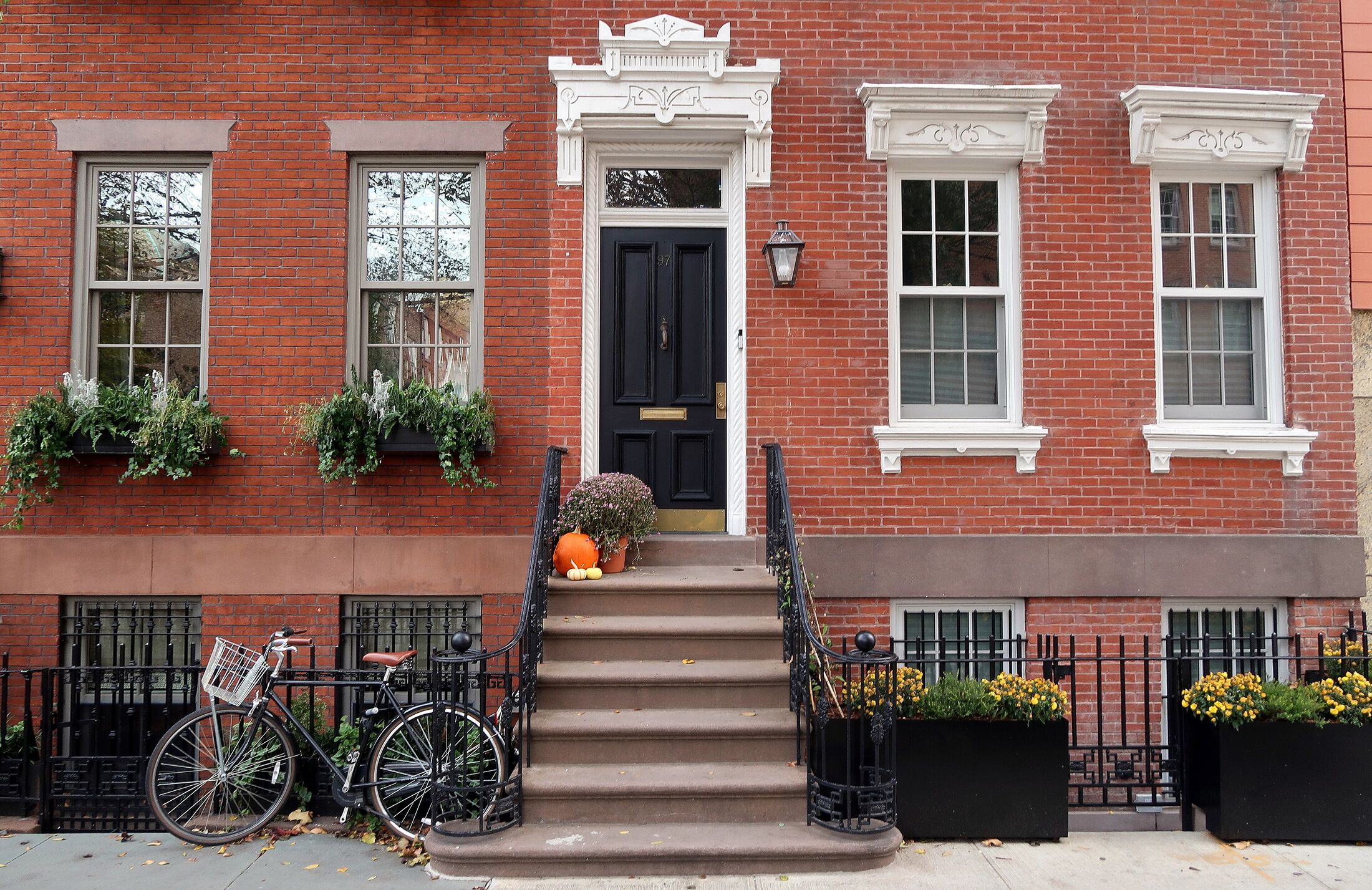
The West Village is the western part of Greenwich Village, bounded by the Hudson River on the west and 14th Street on the north, with its eastern edge usually placed at Sixth or Seventh Avenue and its southern edge at Houston or Christopher Street. It is best known for streets that ignore the Manhattan grid: West 4th Street crosses West 10th, 11th and 12th Streets because the area was laid out before the 1811 plan. The neighborhood holds one of the city's largest concentrations of early nineteenth century rowhouses, along with converted warehouses near the river and a handful of modern towers on the waterfront. Most of it lies within the Greenwich Village Historic District, designated in 1969, plus the Gansevoort Market and Weehawken Street districts. Hudson River Park runs along its western edge, and the Stonewall Inn is a national monument.
Homes and buildings in West Village
Townhouses are the defining property type: Federal and Greek Revival brick houses and later brownstones, some single family and many divided into apartments. Walk-up co-ops and rentals fill smaller buildings, while prewar elevator co-ops and loft conversions appear on the larger streets and near the river. Along the Hudson, a small group of modern condominium towers, including Richard Meier's Perry Street buildings, offer full service living. New construction is limited by landmark protection.
Streets, parks and landmarks
The West Village feels low and intimate, with tree lined streets of brick rowhouses, small triangular parks and corners where streets meet at odd angles. Bleecker, Hudson and Greenwich Streets carry shops and restaurants, while side streets such as Bank, Perry and Charles stay largely residential in scale. Abingdon Square and Christopher Park offer pocket greenery, and Hudson River Park adds piers, lawns and a riverside path.
Selling in West Village
West Village buyers pay a premium for the right townhouse or the right apartment on the right block, so details matter: house width, garden depth, southern light, original mantels and stairs, and whether the house is single family or divided. For apartments, private outdoor space, light and elevator access stand out because the stock is mostly walk-ups. I would document landmark status and any approved work, and position the property around its scarcity.
Compass market data: Compass counts West Village in its Downtown submarket. In Q3 2026 the Downtown submarket’s median sale price was $1,792,500 (+21.5% on a year earlier), on 890 closed sales (+9.9%). Source: Compass Manhattan Market Report Q3 2026 (data: REBNY RLS, ACRIS). NYC market data →
Get Gavin’s report for your building: recent sales in your line and nearby, and what they mean for your price. Free, no obligation.
Buying in West Village
Nearly all of the neighborhood is landmarked, so plan for Landmarks Preservation Commission review on exterior work. In townhouses, check whether apartments are legally configured, review the certificate of occupancy, and budget for older systems. Co-op boards here can be selective, so prepare financial documentation early. Waterfront condominiums carry different costs and amenities than townhouse stock.
West Village: frequently asked questions
Is the West Village a good place to buy an apartment?
It depends on what you value. The West Village is mostly low rise and landmarked, with rowhouses, walk-up co-ops, a few prewar elevator buildings and a small number of modern waterfront condominiums. Supply is limited, which tends to keep competition for well located homes strong. Buyers should weigh walk-up access, outdoor space and co-op requirements against the setting.
What are typical buildings in the West Village?
The signature building is a nineteenth century brick or brownstone rowhouse, three to five stories, either single family or divided into apartments. Walk-up tenements and small apartment buildings fill in the blocks, and some prewar elevator co-ops and converted warehouses stand closer to the river. Modern glass condominiums line a short stretch of the Hudson waterfront.
Which subway lines serve the West Village?
The 1 train runs along Seventh Avenue South with stops at Christopher Street-Stonewall and Houston Street. The A, C, E and L stop at 14th Street and Eighth Avenue on the northern edge, and the West 4th Street station a short walk east adds the B, D, F and M. PATH trains stop at Christopher Street.
Is the West Village a historic district?
Most of it is. It lies largely within the Greenwich Village Historic District, designated in 1969 and extended in 2006 and 2010. The Gansevoort Market Historic District, from 2003, covers the former meatpacking blocks at the north end, and the small Weehawken Street Historic District was designated in 2006. Exterior changes require Landmarks Preservation Commission approval.
Sources: hudsonriverpark.org, nps.gov, mta.info. Neighborhood boundaries are customary and vary by source. Updated October 2026.
More in Downtown Manhattan