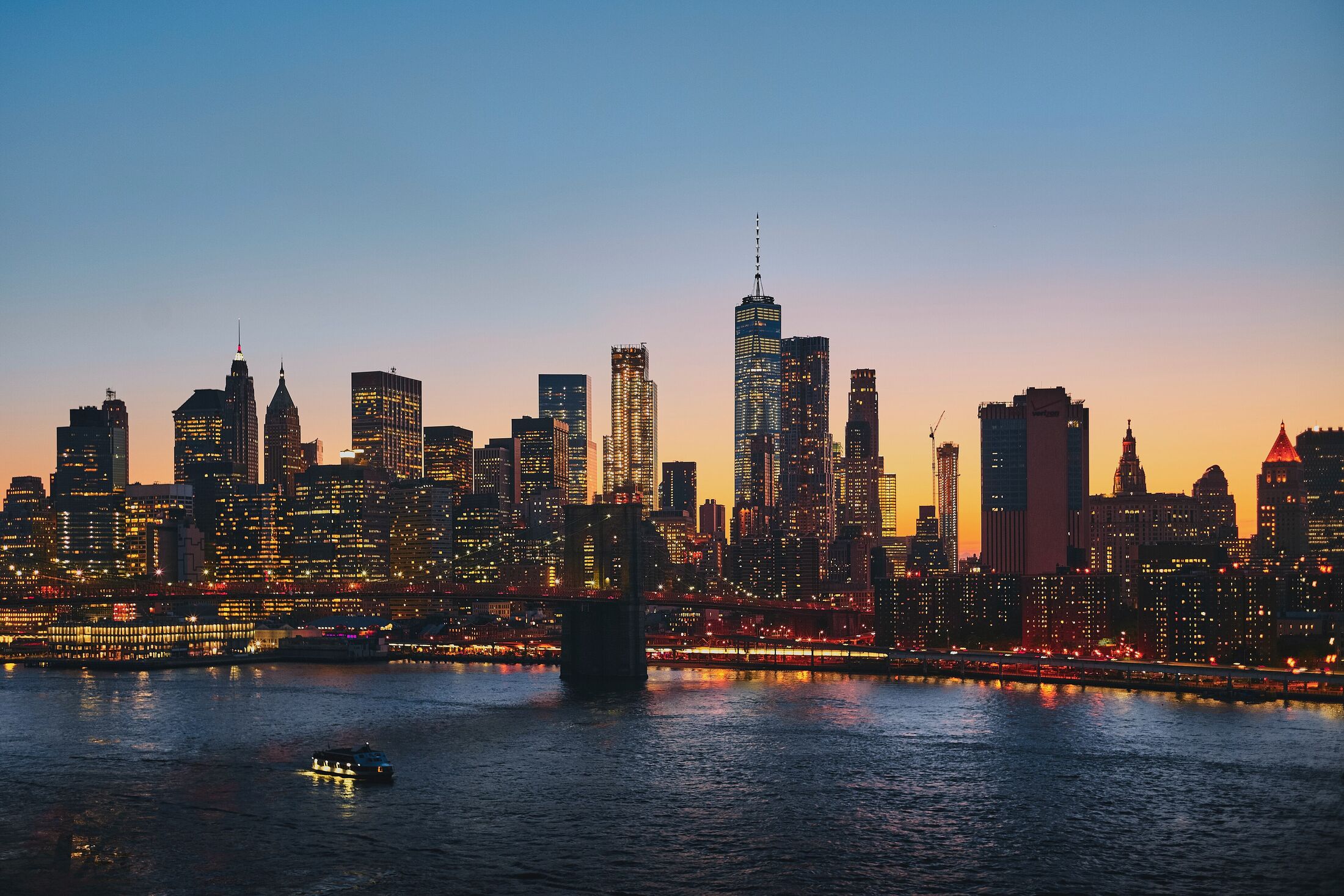
Manhattan · Downtown Manhattan
Chinatown and Two Bridges real estate guide
Chinatown and Two Bridges are adjoining Lower Manhattan neighborhoods stretching roughly from Lafayette and Centre Streets east to the East River, centered on Canal Street and East Broadway, with Two Bridges occupying the waterfront between the approaches of the Brooklyn and Manhattan Bridges. This is one of the oldest built areas of New York. The Edward Mooney House at 18 Bowery, built between 1785 and 1789, is the city's earliest remaining Federal-style townhouse, and the Church of the Transfiguration on Mott Street dates from 1801. Much of the fabric is late nineteenth and early twentieth century tenements with ground-floor shops. In 2010 the Chinatown and Little Italy Historic District was listed on the National Register of Historic Places. Two Bridges adds large mid-twentieth century housing complexes and, more recently, waterfront towers. Canal Street is one of downtown's busiest subway hubs.
Homes and buildings in Chinatown and Two Bridges
Walk-up tenement buildings, often five or six stories with storefronts below, form the bulk of the older stock, and most are rental or held in whole-building ownership. For-sale apartments are concentrated in mid-century co-op complexes near Chatham Square, such as Chatham Green and Chatham Towers, and in newer condominiums, especially in Two Bridges, where One Manhattan Square, an 80-story tower completed in 2019, changed the waterfront skyline. Mixed-use buildings with commercial ground floors are common throughout.
Streets, parks and landmarks
The streets are some of the oldest in Manhattan, with bending lanes like Doyers Street and Mott Street that predate the grid. Columbus Park, laid out in the 1890s on the site of Mulberry Bend, is a central green space. The Museum of Chinese in America on Centre Street, the Kimlau Memorial Arch at Chatham Square and the Church of the Transfiguration are key cultural landmarks. Toward the river, the bridge towers and the East River Esplanade frame Two Bridges.
Selling in Chinatown and Two Bridges
Sellers in this market are usually offering either a co-op in a mid-century complex or a condo in a newer building, and the two attract different buyers. For condos, views of the bridges and the East River, building amenities and common charges are what buyers compare. For co-ops, board policies, maintenance and the building's financial condition dominate. For whole-building or mixed-use owners, the rent roll, commercial leases, legal use and regulatory status are central. National Register listing generally does not restrict private owners the way local LPC designation does, which is useful to explain to buyers.
Get Gavin’s report for your building: recent sales in your line and nearby, and what they mean for your price. Free, no obligation.
Buying in Chinatown and Two Bridges
Ask whether a building participates in any regulatory or affordability program, which can affect resale. Canal Street serves the J, Z, N, Q, R, W and 6 trains; the F stops at East Broadway and the B and D at Grand Street. Large development in Two Bridges has been subject to litigation, so check the status of nearby sites when evaluating views.
Chinatown and Two Bridges: frequently asked questions
Is Chinatown a landmarked historic district?
Not locally. The Chinatown and Little Italy Historic District was listed on the National Register of Historic Places in February 2010, covering roughly Lafayette Street to the Bowery and East Houston to Worth Street. National Register listing is largely honorary for private owners and does not bring the same exterior review as a New York City Landmarks Preservation Commission district. Individual buildings, such as the Edward Mooney House, are separately designated city landmarks.
Where is Two Bridges?
Two Bridges is the waterfront area of the Lower East Side lying between the Brooklyn Bridge and the Manhattan Bridge along the East River, extending inland toward Chinatown and East Broadway. It is defined largely by mid-twentieth century housing complexes, including Knickerbocker Village from 1934, and by recent towers such as One Manhattan Square. The East River Esplanade runs along its edge, and the F train stops at East Broadway.
What is the oldest building in Chinatown?
The Edward Mooney House at 18 Bowery, at the corner of Pell Street, was built between 1785 and 1789 for a butcher named Edward Mooney. It is the earliest remaining Federal-style townhouse in New York City. Nearby, the Church of the Transfiguration on Mott Street was built in 1801 and is one of the oldest church buildings in Manhattan. Both are designated New York City landmarks.
What moves value for apartments in Two Bridges?
For newer condos, unobstructed views of the bridges, river and skyline carry the most weight, followed by amenities and monthly carrying costs. Because several large towers were approved after years of court challenges, buyers want to know how nearby construction might affect light and views. For co-ops in older complexes, maintenance, board policies and any affordability or regulatory restrictions on resale are the main factors.
Sources: hdc.org, new.mta.info. Neighborhood boundaries are customary and vary by source. Updated October 2026.
More in Downtown Manhattan