Manhattan · Downtown Manhattan
Financial District real estate guide
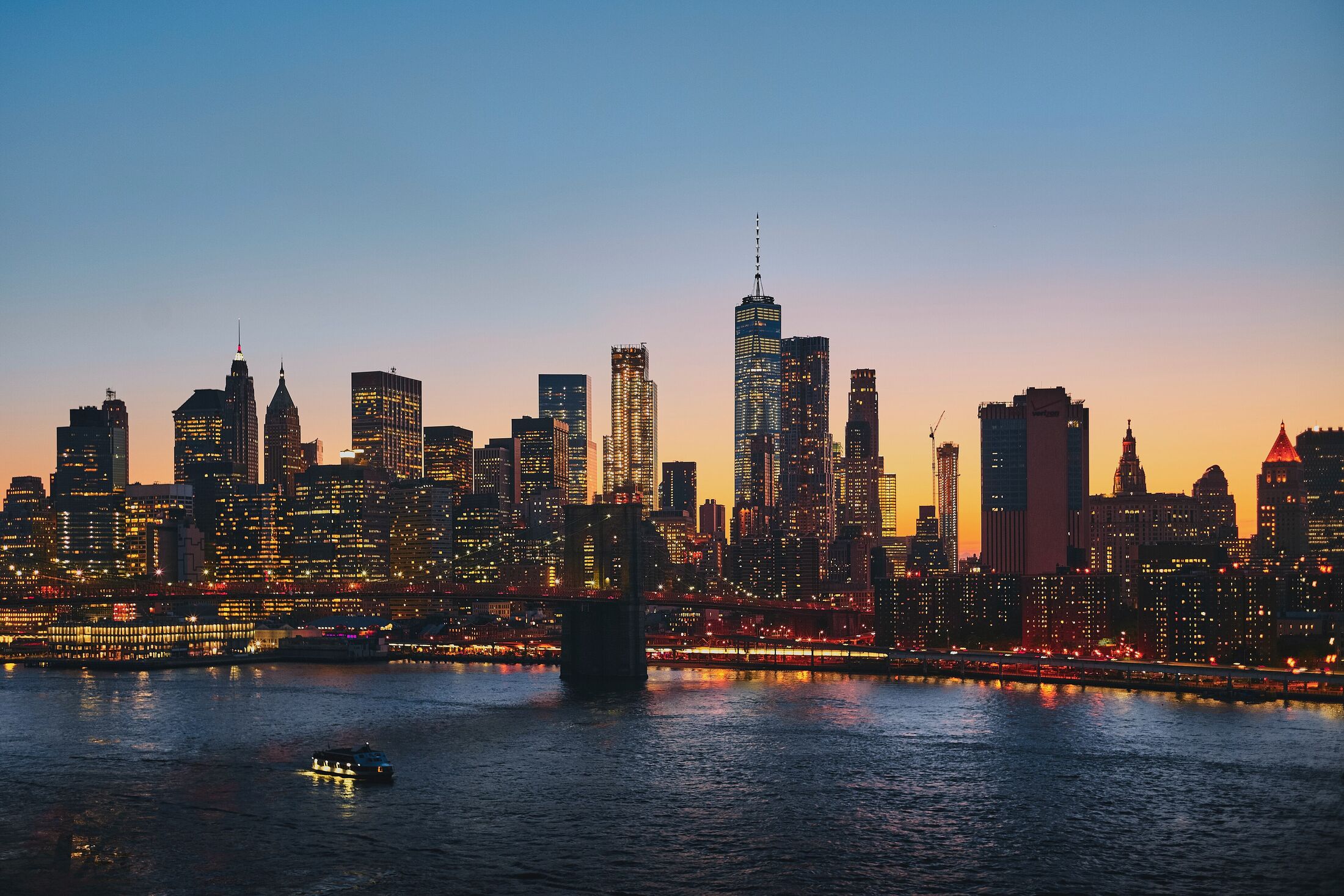
The Financial District is the historic core at the southern tip of Manhattan, running roughly from Chambers Street and City Hall Park down to the Battery, between the Hudson and East Rivers. This is where New Amsterdam began in the 1620s, which is why streets like Stone, Beaver and Pearl still wander instead of following a grid. For most of the twentieth century the area was almost entirely offices, and that changed with the city's 1995 Lower Manhattan revitalization plan, which encouraged converting older office towers into apartments. The rebuilding after 2001 added One World Trade Center, the Oculus and Fulton Center, and conversions have continued since, including 25 Water Street, which opened in 2025 as the largest office to residential conversion in the country. Today the neighborhood mixes prewar skyscrapers, converted lofts and new condominium towers, with Battery Park, Bowling Green and the East River waterfront close at hand.
Homes and buildings in Financial District
Housing here is mostly found in two kinds of buildings: converted prewar office towers and newer purpose built condominiums and rentals. Conversions often bring high ceilings, ornate lobbies and generous amenity floors, but can come with deep floor plates, interior bedrooms or windows that face a neighboring tower. New development tends to offer full service amenities and open views above the surrounding skyline. Co-ops are relatively rare, so condo ownership is the norm, which also suits buyers who plan to rent their apartment out later.
Streets, parks and landmarks
The streets follow the old colonial footprint, so you get narrow, winding blocks like Stone Street, a cobbled pedestrian lane of 1830s commercial buildings, next to Art Deco towers such as 70 Pine and 20 Exchange Place. Bowling Green, laid out in 1733, is the city's oldest public park, and the Battery opens onto the harbor. The South Street Seaport district preserves nineteenth century counting houses and piers along the East River, and Federal Hall and the Stock Exchange anchor Wall Street.
Selling in Financial District
In the Financial District, the details of the individual unit matter more than the address. Buyers compare a lot of similar inventory, so light, exposure and views move price: a high floor with open river or harbor views will compete very differently from a lower floor facing another tower. Layout matters too, since conversions can produce awkward floor plans. I would position a sale around what is genuinely scarce in the building, price against the true comparable lines, and present monthly costs, abatements and building finances clearly so buyers and their lawyers can move quickly.
Compass market data: Compass counts Financial District in its FiDi/BPC submarket. In Q3 2026 the FiDi/BPC submarket’s median sale price was $1,055,000 (−19.2% on a year earlier), on 115 closed sales (−24.8%). Source: Compass Manhattan Market Report Q3 2026 (data: REBNY RLS, ACRIS). NYC market data →
Get Gavin’s report for your building: recent sales in your line and nearby, and what they mean for your price. Free, no obligation.
Buying in Financial District
Check whether a building is a conversion or a ground up development, and read the offering plan for amenity fees, reserve levels and any tax abatement end dates. Ask about windows in bedrooms, light levels at different times of day and the views that could change if a nearby lot is developed. Investors should confirm the rental policy, which is usually flexible in condominiums.
Financial District: frequently asked questions
Is the Financial District a good place to buy an apartment?
It depends on what you value. The Financial District offers a large supply of condominiums, many with full service amenities, and unusually broad transit access, with most downtown subway lines, PATH and ferries within a short walk. Much of the inventory sits in converted office buildings or newer towers, so compare floor plans, light and monthly carrying costs carefully. Condo ownership also gives more flexibility to rent or resell than a typical co-op.
What are typical buildings in the Financial District?
You will mostly find converted prewar office towers and newer condominium or rental high rises. Conversions such as 20 Exchange Place, 70 Pine Street and 25 Water Street turned former office space into apartments, often with high ceilings and large amenity floors. Smaller nineteenth century buildings survive around Stone Street and the South Street Seaport, while new towers add full service living with skyline and water views.
Which subway lines serve the Financial District?
Nearly every major downtown line reaches the area: the 1, 2, 3, 4, 5, A, C, E, J, Z, R and W trains. Fulton Center, which opened in 2014, connects many of these lines under one roof, and the World Trade Center hub adds PATH service to New Jersey. The Staten Island Ferry leaves from Whitehall Terminal, and other ferries run from Pier 11 on the East River.
Is the Financial District a historic district?
Parts of it are. The Landmarks Preservation Commission designated the South Street Seaport Historic District in 1977 and extended it in 1989, the Fraunces Tavern Block Historic District in 1978, and the Stone Street Historic District in 1996. Many individual buildings, including the Woolworth Building and Federal Hall, are separately landmarked. Large stretches of the district, however, are not inside a historic district.
Sources: nycgovparks.org, mta.info, nyc.gov. Neighborhood boundaries are customary and vary by source. Updated October 2026.
More in Downtown Manhattan