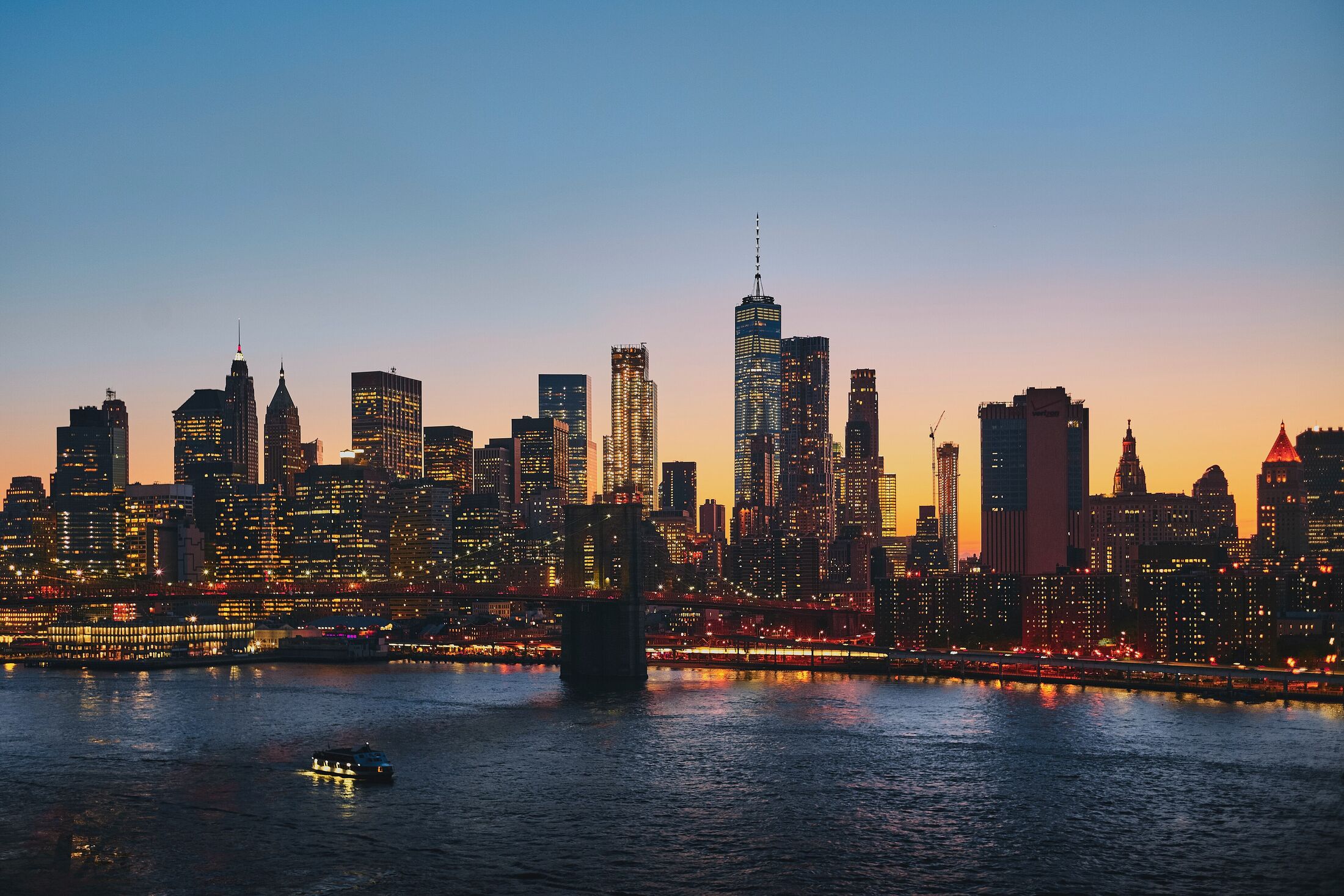
Manhattan · Downtown Manhattan
Tribeca real estate guide
Tribeca is a Lower Manhattan neighborhood of converted warehouses and loft buildings, bounded roughly by Canal Street to the north, Broadway to the east, Chambers Street to the south and the Hudson River to the west. The name, short for Triangle Below Canal, was coined in the early 1970s, when artists were moving into empty industrial lofts. Before that, the area was the city's wholesale food and textile district, anchored by the Washington Market, and its streets are still lined with the cast iron, brick and stone storehouses built for that trade. Four historic districts, designated between 1991 and 1992 and extended in 2002, protect much of that fabric. Today Tribeca combines loft conversions, a smaller number of townhouses and newer condominiums, with Hudson River Park, Duane Park and Washington Market Park among its open spaces.
Homes and buildings in Tribeca
Loft conversions are the heart of the market: former warehouses and factory buildings with high ceilings, large windows, exposed columns and open plans. Many are condominiums, with some co-ops and smaller boutique buildings that have only a few units. A limited number of townhouses survive on streets like Harrison Street. Newer developments, including 56 Leonard, add full service towers. Many older loft buildings were converted in the 1970s and 1980s and have varied layouts.
Streets, parks and landmarks
Tribeca's streets feel built for commerce, with wide loading docks, cast iron storefronts and old brick warehouses along Greenwich, Hudson, Franklin and Laight Streets. Some blocks still have Belgian block paving. Duane Park, one of the oldest public spaces in the city, sits among nineteenth century storehouses, and Hudson River Park's Pier 25 and Pier 26 offer lawns and river access. The Tribeca Festival, founded after 2001, is based here.
Selling in Tribeca
Buyers in Tribeca are typically after authentic loft space, so ceiling height, column layout, window count and light do the heavy lifting on price. A true full floor loft with a keyed elevator, original details and good exposure stands apart from a carved up unit. Private outdoor space and parking are rare and valuable. I would present the loft's history, ceiling height and dimensions precisely, stage to show volume, and price against genuinely comparable lofts rather than nearby new construction.
Compass market data: Compass counts Tribeca in its Downtown submarket. In Q3 2026 the Downtown submarket’s median sale price was $1,792,500 (+21.5% on a year earlier), on 890 closed sales (+9.9%). Source: Compass Manhattan Market Report Q3 2026 (data: REBNY RLS, ACRIS). NYC market data →
Get Gavin’s report for your building: recent sales in your line and nearby, and what they mean for your price. Free, no obligation.
Buying in Tribeca
Ask whether the loft has a legal certificate of occupancy for residential use and whether light and ventilation meet code for every bedroom. In landmark districts, exterior changes such as new windows or rooftop additions need Landmarks Preservation Commission approval. Check the building's elevator situation, since some smaller loft buildings rely on freight or keyed elevators, and review co-op versus condo rules carefully.
Tribeca: frequently asked questions
Is Tribeca a good place to buy an apartment?
It depends on the kind of home you want. Tribeca has one of the largest concentrations of converted loft apartments in Manhattan, many with high ceilings and large windows, plus newer condominiums and a limited number of townhouses. Much of the neighborhood is protected by historic districts, which limits new construction. Waterfront parks along the Hudson and several subway lines are close by.
What are typical buildings in Tribeca?
Most residential buildings are former warehouses, factories and storehouses converted into lofts, often five to twelve stories with cast iron or brick facades. They range from small boutique co-ops with a handful of units to large condominium conversions. Newer towers such as 56 Leonard Street add full service options, and a few early nineteenth century townhouses survive on streets like Harrison Street.
Which subway lines serve Tribeca?
The 1 train stops at Franklin Street and Canal Street, and the 1, 2 and 3 stop at Chambers Street. On the eastern side, the A, C and E stop at Canal Street and the A and C at Chambers Street. Canal Street stations also connect to the N, Q, R, W, J, Z and 6 a short walk east, and PATH runs from the World Trade Center.
Is Tribeca a historic district?
Much of it is. The Landmarks Preservation Commission designated four Tribeca historic districts: Tribeca West in 1991, and Tribeca East, Tribeca North and Tribeca South in 1992, with an extension of Tribeca South in 2002. Exterior work on buildings inside these districts, such as window replacements or rooftop additions, requires commission approval.
Sources: nycgovparks.org, mta.info, nyc.gov. Neighborhood boundaries are customary and vary by source. Updated October 2026.
More in Downtown Manhattan