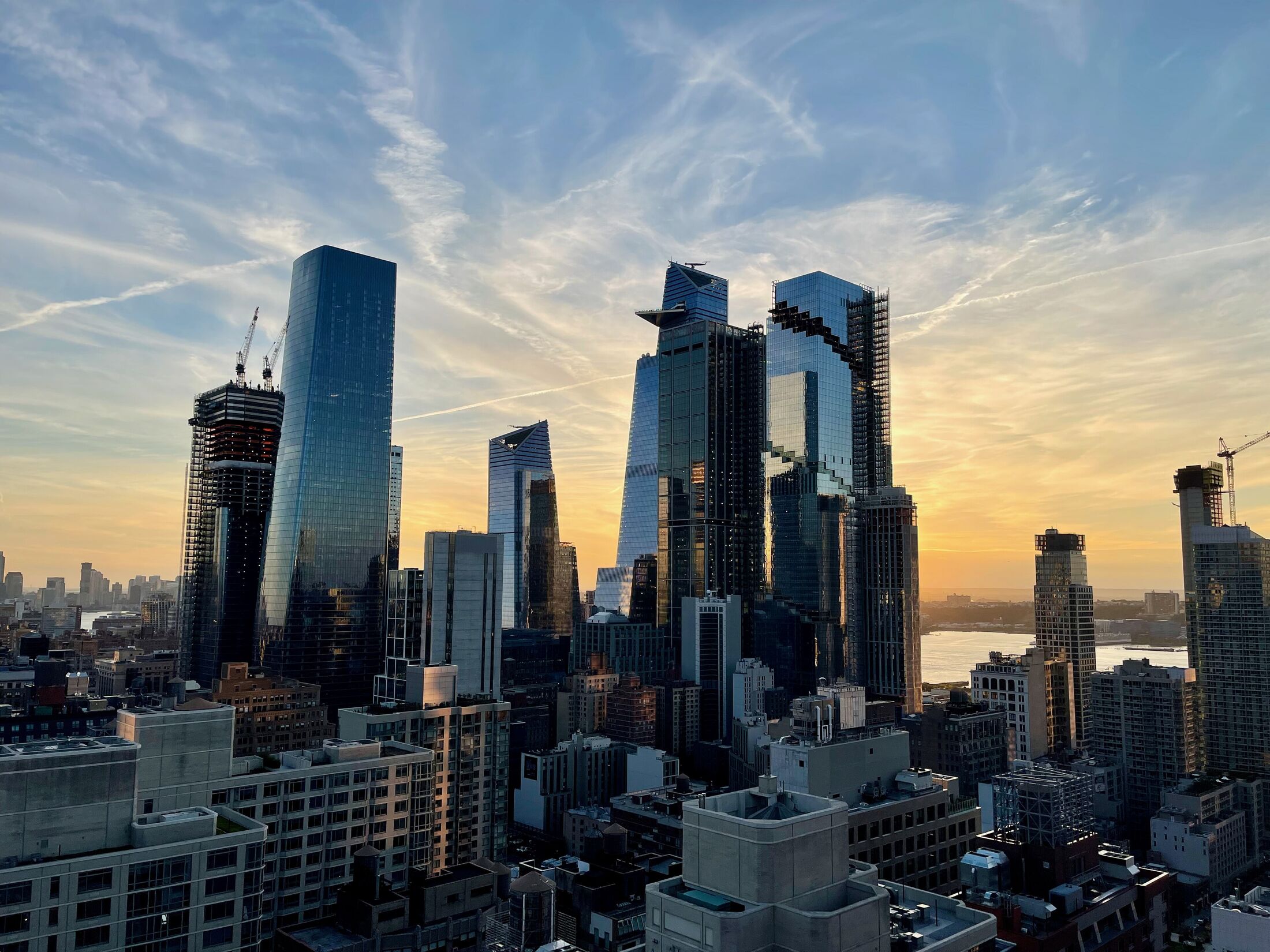
Manhattan · Downtown Manhattan
Hudson Yards real estate guide
Hudson Yards is a Far West Side neighborhood bounded roughly by 30th Street to the south, 41st Street to the north, Eighth Avenue to the east and the Hudson River to the west. For most of the twentieth century it was dominated by rail yards, warehouses and the approaches to the Lincoln Tunnel. A 60 block rezoning approved in January 2005 opened the area to large scale development, and the extension of the 7 train to a new 34th Street-Hudson Yards station in September 2015 connected it to the subway. The first phase of the Hudson Yards development, built on a platform over the Eastern Rail Yard, opened in March 2019 with offices, shops, the Vessel and The Shed. In 2025 the City Council approved plans for the next phase over the Western Rail Yard, with up to 4,000 homes and a park.
Homes and buildings in Hudson Yards
Almost all housing here is new construction from the 2010s and 2020s: glass condominium towers, including 15 Hudson Yards and 35 Hudson Yards, and large amenity rich rental buildings. Units often feature floor to ceiling windows, central air and hotel style services. A few older walk-ups and tenements remain on side streets toward Eighth Avenue. Because buildings are new, many condominiums carry tax abatements and initial sponsor pricing.
Streets, parks and landmarks
Hudson Yards is defined by large modern buildings, plazas and new public spaces. Hudson Yards' public square holds the Vessel, a climbable lattice by Thomas Heatherwick, and The Shed arts center. Bella Abzug Park and Hudson Boulevard run north between 33rd and 39th Streets, and the High Line ends here at the rail yards. The Javits Center sits to the northwest, and the Edge observation deck projects from 30 Hudson Yards.
Selling in Hudson Yards
In Hudson Yards, sellers often compete with sponsor units in the same building or nearby, so pricing must account for new development incentives. Floor height, Hudson River and skyline views, exposure and layout are the main drivers, along with amenities and building services. I would position a resale against sponsor inventory by emphasizing immediate availability, finished units and value relative to new listings, while presenting abatement status and common charges clearly.
Compass market data: Compass counts Hudson Yards in its Midtown West submarket. In Q3 2026 the Midtown West submarket’s median sale price was $982,500 (+4.0% on a year earlier), on 114 closed sales (+0.9%). Source: Compass Manhattan Market Report Q3 2026 (data: REBNY RLS, ACRIS). NYC market data →
Get Gavin’s report for your building: recent sales in your line and nearby, and what they mean for your price. Free, no obligation.
Buying in Hudson Yards
Ask about the building's tax abatement schedule and how common charges and taxes will change over time. Compare resale and sponsor pricing in the same building. Views can change as the Western Rail Yard and other sites are developed, so review approved plans. Confirm amenity fees and any club or membership costs that sit outside common charges.
Hudson Yards: frequently asked questions
Is Hudson Yards a good place to buy an apartment?
It depends on what you value. Hudson Yards offers new construction with full service amenities, large windows and views of the Hudson and skyline, served by the 7 train and close to Penn Station. Buyers should study tax abatement schedules, compare resale units with sponsor inventory, and consider how planned development on the Western Rail Yard could change views over time.
What are typical buildings in Hudson Yards?
The neighborhood is mostly new glass towers built since the 2010s. Residential examples include the 15 Hudson Yards and 35 Hudson Yards condominiums and several large rental buildings with extensive amenities. Office towers, a shopping center and cultural venues such as The Shed share the same platform, and a few older walk-ups remain toward Eighth Avenue.
Which subway lines serve Hudson Yards?
The 7 train ends at 34th Street-Hudson Yards, a station that opened in September 2015 as part of the Flushing Line extension. Penn Station, a short walk east, adds the A, C, E, 1, 2 and 3 trains along with Long Island Rail Road, NJ Transit and Amtrak. Crosstown buses on 34th and 42nd Streets also serve the area.
What is being built on the Western Rail Yard?
In 2025 the City Council approved Related Companies and Oxford Properties' plan for the next phase of Hudson Yards over the Western Rail Yard. The plan calls for up to 4,000 homes, including at least 625 affordable units, a 6.6 acre park and an office tower, built on a platform over active rail lines. Timing and phasing should be confirmed with current reports.
Sources: mta.info, nycgovparks.org. Neighborhood boundaries are customary and vary by source. Updated October 2026.
More in Downtown Manhattan