Brooklyn · Neighborhood guide
Park Slope real estate guide
Park Slope is the neighborhood that climbs the western slope toward Prospect Park, running from Flatbush Avenue south to roughly the Prospect Expressway and from Fourth Avenue east to the park. Prospect Park, the 526-acre park designed by Frederick Law Olmsted and Calvert Vaux and opened in 1867, anchors its eastern edge, and Grand Army Plaza marks the northern corner. Most of the housing went up between the 1870s and the early 1900s, from Italianate brownstones to Romanesque Revival and Queen Anne mansions near the park. The Landmarks Preservation Commission designated the Park Slope Historic District in 1973 with 1,948 buildings, then extended it in 2012 and again in 2016, bringing the total to about 2,853 buildings. Fifth Avenue and Seventh Avenue are the main commercial streets. The F and G, 2 and 3, B and Q, and R trains all serve the neighborhood.
Homes and buildings in Park Slope
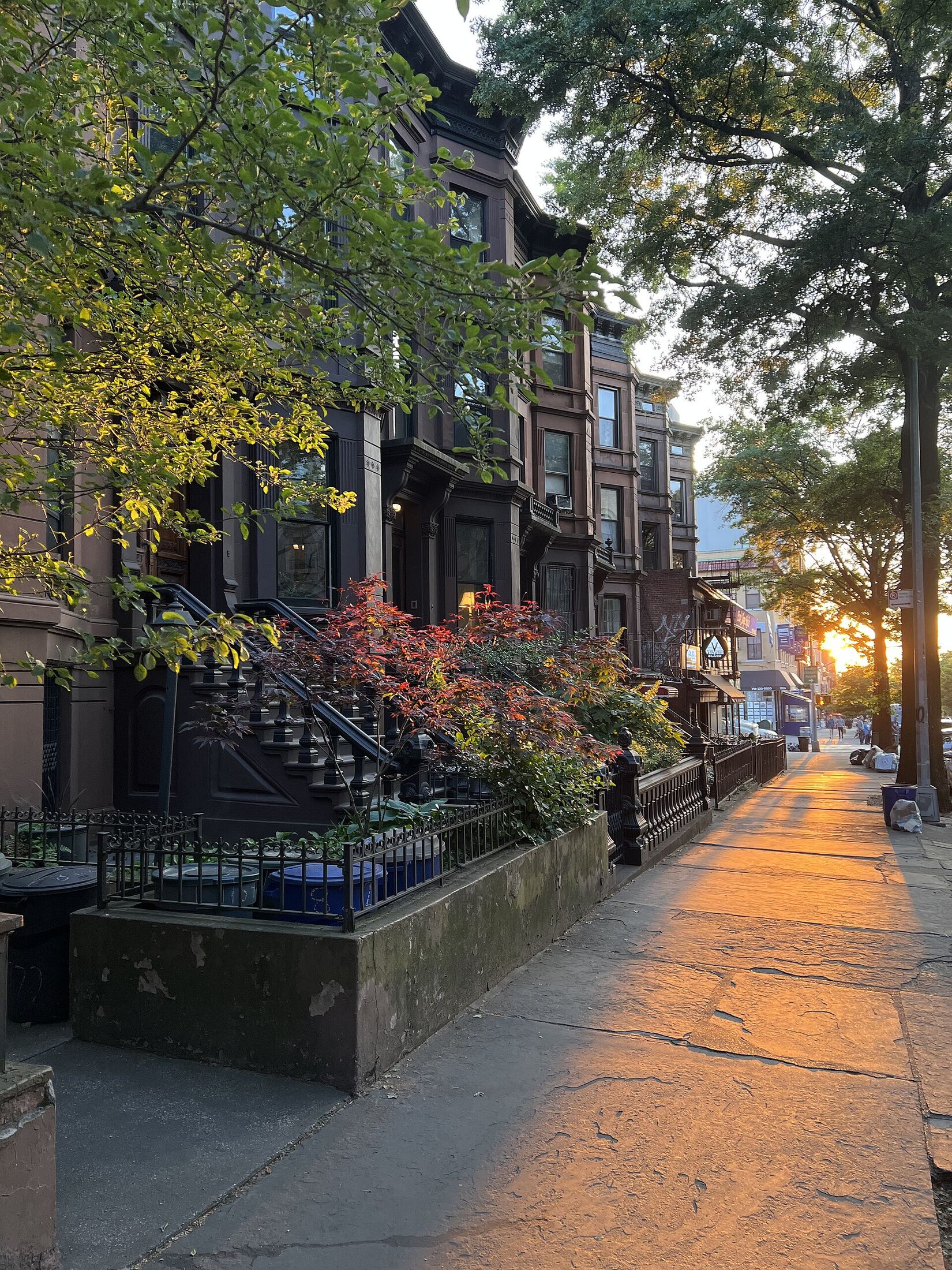
Park Slope has one of the largest concentrations of brownstone and brick rowhouses in the city, ranging from narrow two-family houses to wide single-family mansions near the park. Limestone and brick Romanesque Revival houses cluster in the North Slope. Prewar co-op and apartment buildings line Prospect Park West and Eighth Avenue, and newer condominiums appear along Fourth Avenue, which was rezoned in 2003 for taller buildings. Many houses are divided into two to four units.
Streets, parks and landmarks
Streets slope gently uphill toward the park and are lined with mature trees and long rows of stoops. Fifth and Seventh Avenues carry dense stretches of shops and restaurants, and Grand Army Plaza holds the Soldiers' and Sailors' Memorial Arch and the Brooklyn Public Library's Central Library. Landmark buildings include the Montauk Club. Prospect Park adds the Long Meadow, a lake, ballfields, and the Picnic House within a few blocks of most homes.
Selling in Park Slope
Park Slope's townhouse market is competitive. Well-priced houses often draw several offers and sell above asking. The details that move price are proximity to the park, a parlor floor with original woodwork, pocket doors, and plaster, garden access, and single-family or easily converted layouts. Sun exposure matters on the north-south avenues. Accurate pricing and a clean legal file let competition work in your favor.
Compass market data: Compass counts Park Slope in its Northwest Brooklyn submarket. In Q3 2026 the Northwest Brooklyn submarket’s median sale price was $1,570,000 (+0.3% on a year earlier), on 755 closed sales (−1.6%). Source: Compass Brooklyn Market Report Q3 2026 (data: REBNY RLS, ACRIS). NYC market data →
Get Gavin’s report for your building: recent sales in your line and nearby, and what they mean for your price. Free, no obligation.
Buying in Park Slope
Most blocks between Flatbush Avenue and the southern Slope fall inside one of the three historic district designations, so confirm status before planning exterior work. Fourth Avenue and parts of the South Slope allow larger new buildings. Expect competition for well-priced houses near the park, and come prepared with financing and inspections lined up. Older houses can need masonry, roof, and stoop repairs.
Park Slope: frequently asked questions
How large is the Park Slope Historic District?
It is one of the largest in the city. The original district, designated in July 1973, covered 1,948 buildings. The Landmarks Preservation Commission added 613 buildings in the South Slope in April 2012 and 292 buildings in the North Slope in April 2016, for a total of about 2,853 buildings. Exterior work in the district requires commission review.
How competitive is the Park Slope market right now?
Very competitive for well-priced homes. In 2026 Park Slope has been one of the city's strongest markets, and well-presented houses near the park often sell above asking. Demand is a signal, not a guarantee: each house still sells on its own condition, block and price.
What architectural styles define Park Slope?
Italianate and Neo-Grec brownstones fill many side streets, while the North Slope and blocks near Prospect Park West feature Romanesque Revival and Queen Anne houses in brownstone, brick, and limestone, some with turrets and bay windows. Prewar apartment buildings line Prospect Park West and Eighth Avenue. Most of this stock was built between the 1870s and the early 1900s.
What features add the most value to a Park Slope home?
Proximity to Prospect Park is the clearest premium, especially on the blocks nearest Prospect Park West. Inside, buyers look for a parlor floor with original woodwork, pocket doors, mantels, and plaster detail, plus private garden access. Single-family layouts or houses that convert easily draw the widest pool. Good light, updated systems, and a complete permit and Landmarks record support the final number.
Sources: nycgovparks.org, new.mta.info. Neighborhood boundaries are customary and vary by source. Updated October 2026.
More in Brooklyn